
Faster employment growth for new immigrants

Statistics Canada’s economic and social report has revealed that, after years of disparity, new immigrants in Canada are now seeing faster employment rate growth than their Canadian-born peers.
In addition to this employment growth, new immigrants (aged 25-54) in Canada are now shrinking the employment gap between themselves and their Canadian peers and contributing disproportionately to Canadian innovation and business ownership.
Schedule a Free Work Permit Consultation with the Cohen Immigration Law Firm
Continued improvement in labour market outcomes for immigrants in Canada
Since the early 2010s, immigrants in Canada have seen an upward trajectory in their labour market outcomes.
Recent immigrants aged 25-54 years old saw a growth of 10.7% in their employment rate between 2010 and 2023. Within the same time frame, the employment growth rate among Canadian-born workers was 4.1%.
Accordingly, the employment rate gap between these groups has drastically decreased in the last 10 years. In 2010, the gap in employment rate between recent immigrants and the Canadian-born population was 13.1%. In 2023, this gap was only 6.5%, indicating that newcomers as a group are on track to outpace their Canadian-born peers in terms of finding and securing employment in Canada.
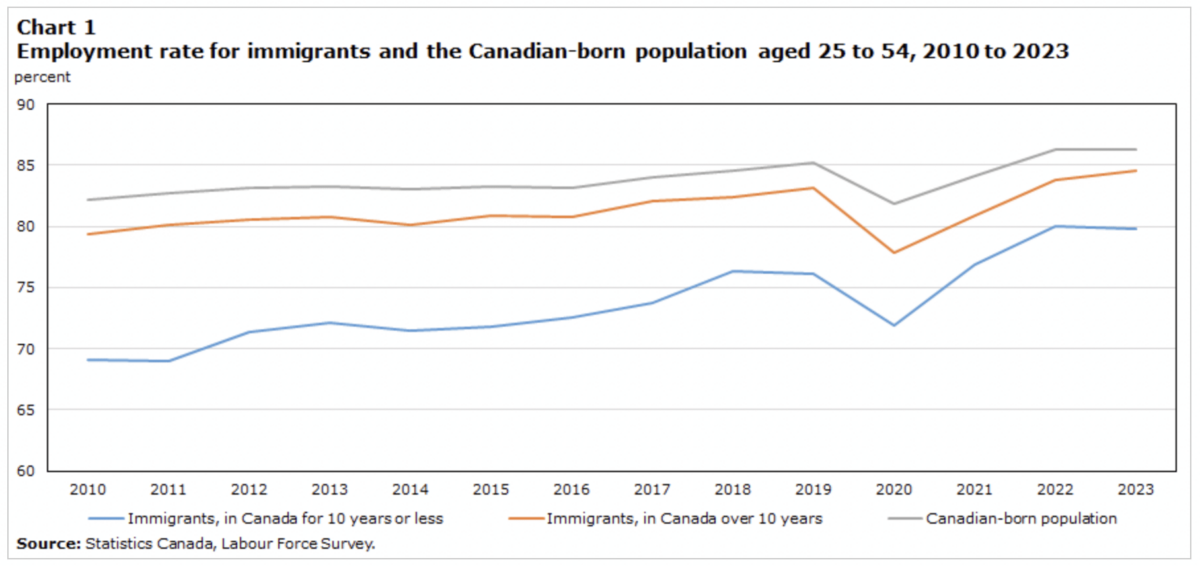
Furthermore, unemployment rate differences have also dropped when comparing the two groups. For recent immigrants in the studied age group, unemployment rates dropped from 12.1% in 2010, to 6.6% in 2023—reducing the gap in unemployment rates between recent immigrants and Canadian-born workers to just a 2.6% difference.
Immigrants also exhibited a faster recovery after the COVID-19 pandemic, where they experienced significant employment setbacks as a group, which were especially noted among those employed in accommodation food services, and retail trade sectors. However, when comparing the gap in employment rate among Canadian-born workers and recent immigrants, this gap was lower than 2019 pre-pandemic levels—indicating that employment growth among recent immigrants between 2020 and 2023 was especially strong.
Growing immigrant participation in patents and investments
According to another study cited by the economic and social report, immigrants were over-represented among patent filers in Canada—contributing more than one-third of all patents, despite only making up a fourth of the Canadian population.
In addition to this, the study also noted increased immigrant participation among investors in Canada—indicating yet another way that newcomers are contributing to Canadian business and innovation. In 2019, immigrant men made up 34.2% of investors in Canada, while immigrant women were 44.3% of investors in the same year. Again, considering that immigrants only make up roughly 25% of the Canadian population, it becomes clear that this group disproportionately contributes to the national profile of innovation and business in the country.
Why might this be the case?
The study points to a few key changes in the immigration landscape of Canada, that could provide explanations as to why immigrants in the country are continuing to do so well.
The first is the rise in immigration candidates who previously held work permits in Canada. Data cited reveals that in 2022, 36% of all new immigrants granted PR in Canada had held a work permit before immigration. This trend has been steadily increasing, with 19% of immigrants holding work permits before immigration in 2010, and 33% in 2019. There is extensive literature to suggest that those with prior work experience in Canada (especially with higher-skilled jobs) tend to have better immigration outcomes than those who have not had this experience.
The second reason is the introduction of the Express Entry management system, which uses the Comprehensive Ranking System (CRS) to assess candidates and choose new economic immigrants. The CRS greatly favours Canadian work experience (meaning that those who have this benefit will receive higher scores, and are subsequently more likely to be picked for immigration); but also other human capital factors that have been shown to correspond to better labour market outcomes in Canada—such as official language proficiency, and education (which is assessed rigorously (if not in Canada, through education credential assessments)). The introduction of this system has largely helped Canada choose economic immigrants who are more likely to perform well in the labour market.
Schedule a Free Work Permit Consultation with the Cohen Immigration Law Firm
- Do you need Canadian immigration assistance? Contact the Contact Cohen Immigration Law firm by completing our form
- Send us your feedback or your non-legal assistance questions by emailing us at media@canadavisa.com